 Dakhilaa
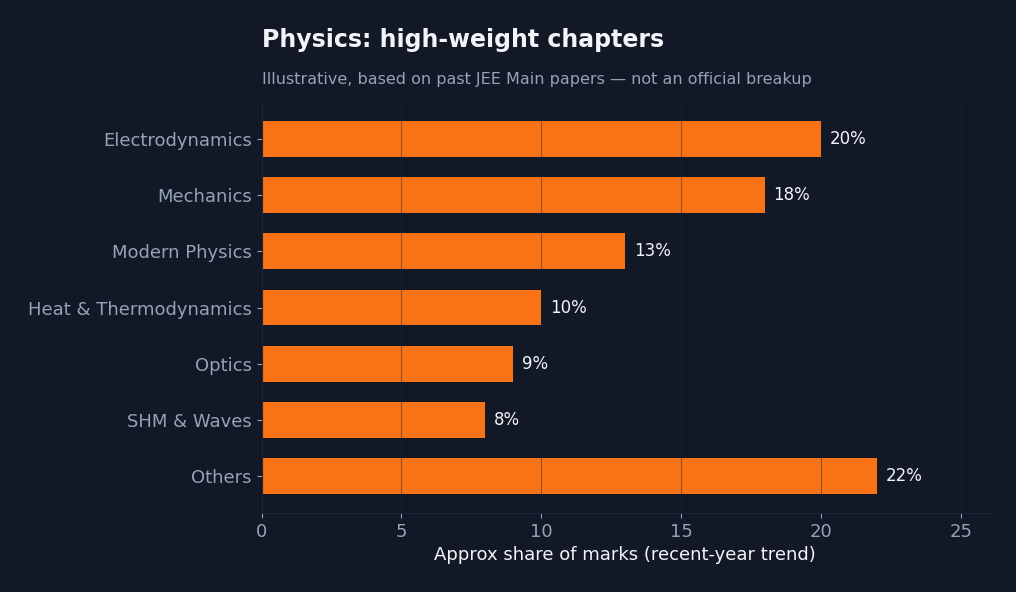
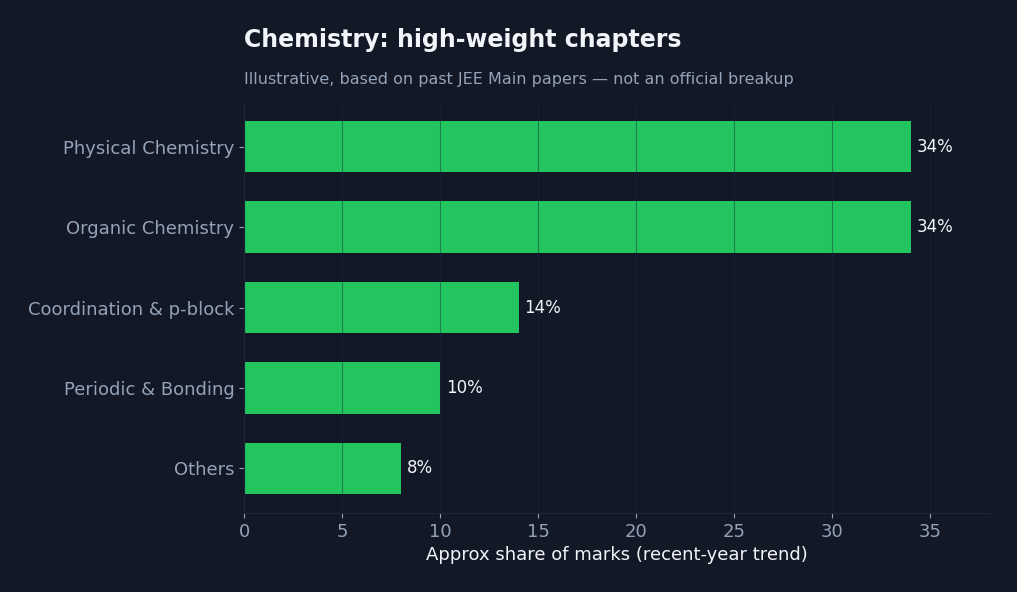
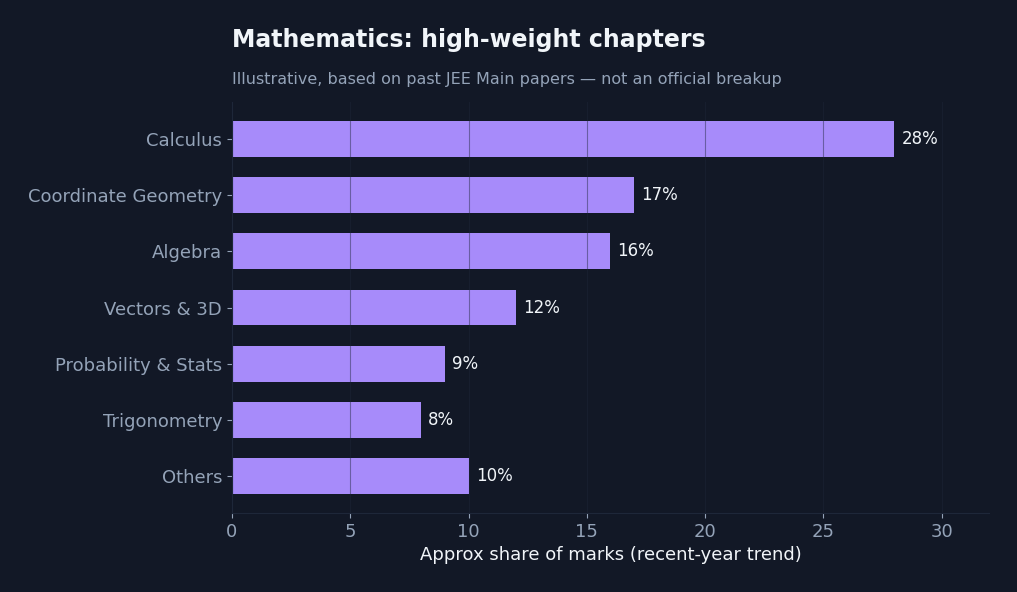
Not all chapters are equal. A handful carry a large share of the paper every year, and getting those solid is worth more than perfecting a low-yield topic. Here is the approximate weightage by subject — based on recent papers, not an official NTA breakup, so use it as a priority map.
Physics
Physics marks concentrate heavily in Electrodynamics and Mechanics, with Modern Physics close behind. If those three are shaky, your Physics score has a ceiling.
Chemistry
Chemistry is the most balanced of the three, split fairly evenly between Physical and Organic, with Inorganic a steady scorer. Inorganic is the highest return-on-effort area — it is mostly memory, not problem-solving.
Mathematics
Maths is front-loaded by Calculus, followed by Coordinate Geometry and Algebra. Calculus alone can make or break your Maths section.
Weightage tells you where the marks are. Your own accuracy tells you where YOUR marks are leaking. You need both to prioritise well.
The smartest move is to overlay the two: find the chapters that are both high-weight and currently weak for you. That intersection is your fastest score gain — and it is exactly what Dakhilaa's weak-topic report surfaces after a short test.